Who I am, and why I'm building in public now
Soon, someone is going to decide whether to trust me. They won't ask me. They'll ask an AI.
I know how this works, because I do it too. A few weeks ago I needed a voice recorder. I didn't read ten review sites. I described what I needed to an AI, my budget, how I'd use it, what actually mattered to me, and it pointed me to the Olympus WS-882. I bought it. The people who market voice recorders had nothing to do with that decision. An agent interpreted the options, and I trusted the interpretation.
What just broke
For twenty-five years the internet ran on attention. You shouted, you got eyeballs, you pushed people down a funnel. That era is ending. We are moving to an interpretation economy, where the web is filtered through what an AI thinks about you. And it works the same way for hiring as it does for voice recorders. Hiring managers already trade prompts to find candidates. The first question about me will be answered by a machine reading whatever I left on the internet.
The part most people keep private: between 2023 and 2024 I sent around 700 job applications. Then another 500 from September 2025 to June 2026. Twelve hundred applications. Tailored CVs, AI-written cover letters, keyword-matched searches. I got very good at the back-office motions of job hunting. And here is what it taught me: none of that is a differentiator anymore. Everyone does it. It is table stakes now, the noise everyone produces.
I am not telling you this to complain about the market. I survived it, and lately I have started to do more than survive. I am telling you because the lesson was not cheap. It cost me a lot of trying, and close to two years of income, before it sank in. I have stopped treating that as money lost and started treating it as tuition: what I paid to learn how this new world works, and how to move in it.
Optimizing the old motion harder does not work once the game has changed.
Proof, not promises
What works is proof. Not the dressed-up LinkedIn or the emotional language everyone leans on, but evidence an agent and a human can both read and verify.
As a product owner I am lucky here: my work produces public artifacts. Sprint outcomes, the decisions behind them, the reasoning that put a backlog in that order in the first place. I can show the work instead of claiming it, so I will. This site, this blog, the things I ship in the open, they are my truth layer. When someone asks what I can do, I want the answer already on the table, provable.
First, a quick introduction, so it is easy to read. I started at the customer front line: troubleshooting tickets, writing docs nobody read, taking the escalations nobody wanted. Twelve years later, across Vodafone, Microsoft, and Okta, I went from support to product ownership, with a long detour through strategy in between. I am technically grounded. I still read the docs before I write the requirements. That is the habit everything else is built on, not a slogan.
Opinions, finally in public
The harder part of proof is having opinions. I learned that one the painful way.
Thirteen years ago I covered an Apple iPhone launch on my blog, fast and clean. The problem was that it was pure relay, copy-paste, with not a single opinion of my own. A couple of weeks later, at Webstock, a well-known blogger stopped mid-talk and asked the room: "Is Tudor Crețu here?" Then he held up my post as the example of exactly what not to write. His point, and he was right, was simple: people can find the news anywhere. They come to a blog to read your opinion. And once you have a brand, they come specifically for yours.
It stung, and it stuck with me long afterward, which is why for years I kept my opinions mostly private. I have plenty now, and I am finally ready to put them in public. In an interpretation economy that is not a nice-to-have. Agents flatten everyone without a point of view into the average of their category. If you want to be found, be specific, be opinionated, and be ready to defend the opinion when someone pushes back.
From "Tudor de la Vodafone" to my own name
There are two ways to get chosen. An agent interprets the options and picks, or a human asks for you by name. I want the second one.
A few years ago I read Cal Newport's So Good They Can't Ignore You, and it named something I had already lived. Between 2012 and 2018 at Vodafone I became "Tudor de la Vodafone", the person you went to when you had a problem and needed it solved. That reputation was real, but it was tied to a company. This time I am building it in my own name. I want to be known as Tudor Crețu: a product owner and builder, a founder of products and communities, working on my own or alongside teams as capable as the work demands.
A full calendar, on purpose
Building memory in people has not become less important in the age of AI. It has become more important. The agent compares and summarizes, but the human still applies the preference. That is why I run Design Unfold, why I show up in real life, why I write this.
And it is why, for the first time, my week looks like this.
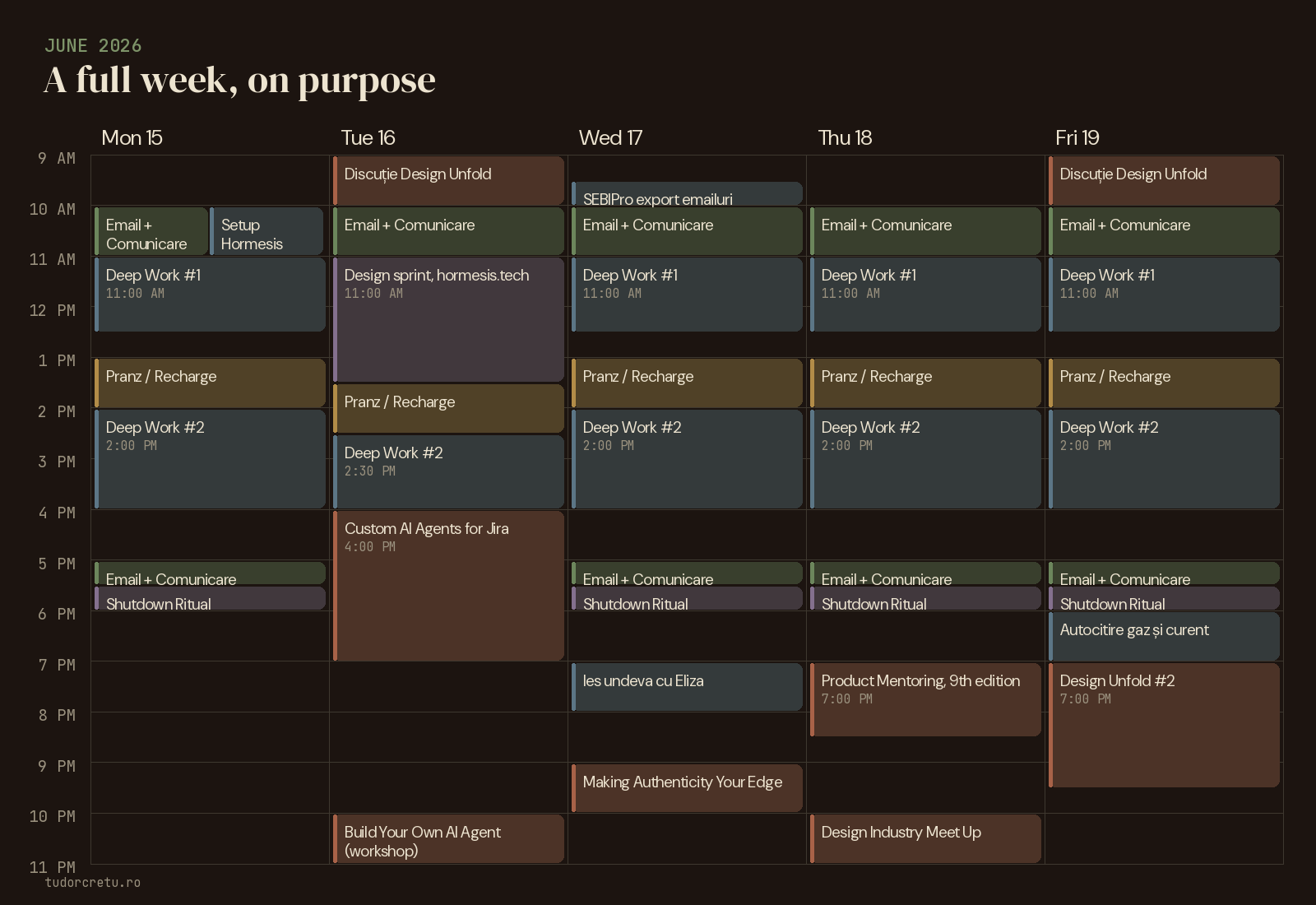
A full calendar, on purpose. I have never had this kind of clarity before. It lets me rise a little higher, look at the whole picture, and follow the paths that are actually mine, without losing the time I used to lose.
Antifragile, in the open
I will not pretend to be more AI-native than I am, because that is a debt that comes due at delivery. Instead I work with these tools in the open, every day, and I show the receipts. SEBI, the knowledge system I am building. This blog, which I publish straight from my terminal. The agents I wire into my own work.
The point is antifragility. The next time someone asks me "do you actually know how to work with AI?", and I hope that question gets rarer, I want my answer to be: not only do I know, let me show you four or five use cases for your company, exactly how I would apply them, and the steps I would take.
The work worth building a life around
The most useful idea I took from all this is an audit I picked up from Nate B Jones, whose writing shaped a lot of how I now think about this shift. You tag every piece of your week as theater, commodity, work that is on the line, or the durable kind. Theater is work that exists so the organization can perform. Commodity is real work, just work that does not need you specifically. Durable work is where you changed the question instead of answering it, where the outcome would have degraded without you in the room.
AI absorbs theater and commodity quickly. Durable work compounds to you. I want my week, and my career, organized around the durable part.
I recently read Endure by Alex Hutchinson. Its argument is that endurance is the struggle to continue against a mounting desire to stop, and that our limits are set as much by the mind as by the body, far more elastic than they feel in the moment. Those twelve hundred applications were my version of that. The desire to stop was real, and the limit kept moving anyway. What I am changing now is where I point that endurance: not at more of the old motion, but at durable work that compounds, at a pace I can actually hold. Something sustainable enough to give me the space, and eventually the means, to invest back. In other people, and in initiatives that help those stuck in the same problems I just described.
The real obstacle to all of this is identity. The audit, and the last few years, force you to update the story you tell yourself about your own value. That update is expensive now and pays off later. I would rather make it on my own terms than have an organization make it for me. That is what building in public is for.
So that is who I am, and why I am doing this now. I know I like to work, and I like to make things that are genuinely good. If that is true, then everything from here should only turn out better.
If you care about craft, value autonomy, and want to build better products, this is the conversation I am trying to have. Stick around.
Comments