I still read the docs first
Fourteen years ago, my job was to answer customers in public. Turning the company's internal documentation into something anyone could find and read was not in the job description. I did that part on my own.
I was a moderator on a Romanian telecom forum. I registered in January 2012. I had been answering support questions there for a few months when I started a side project: take the internal know-how, the stuff locked inside the company, and rewrite it for the outside. I adjusted the language so a normal person could follow it. I added screenshots, links to other resources, and files to download.
And I made it findable. I wanted someone typing "ras error 635" into Google to land straight on the fix. So I tagged almost every article on the site, not just mine, because I could see the cross-references and knew the platform would recommend better if I did. Nobody asked me to. I ran it past the customer service team, then just did it. It ended up in my performance reviews.
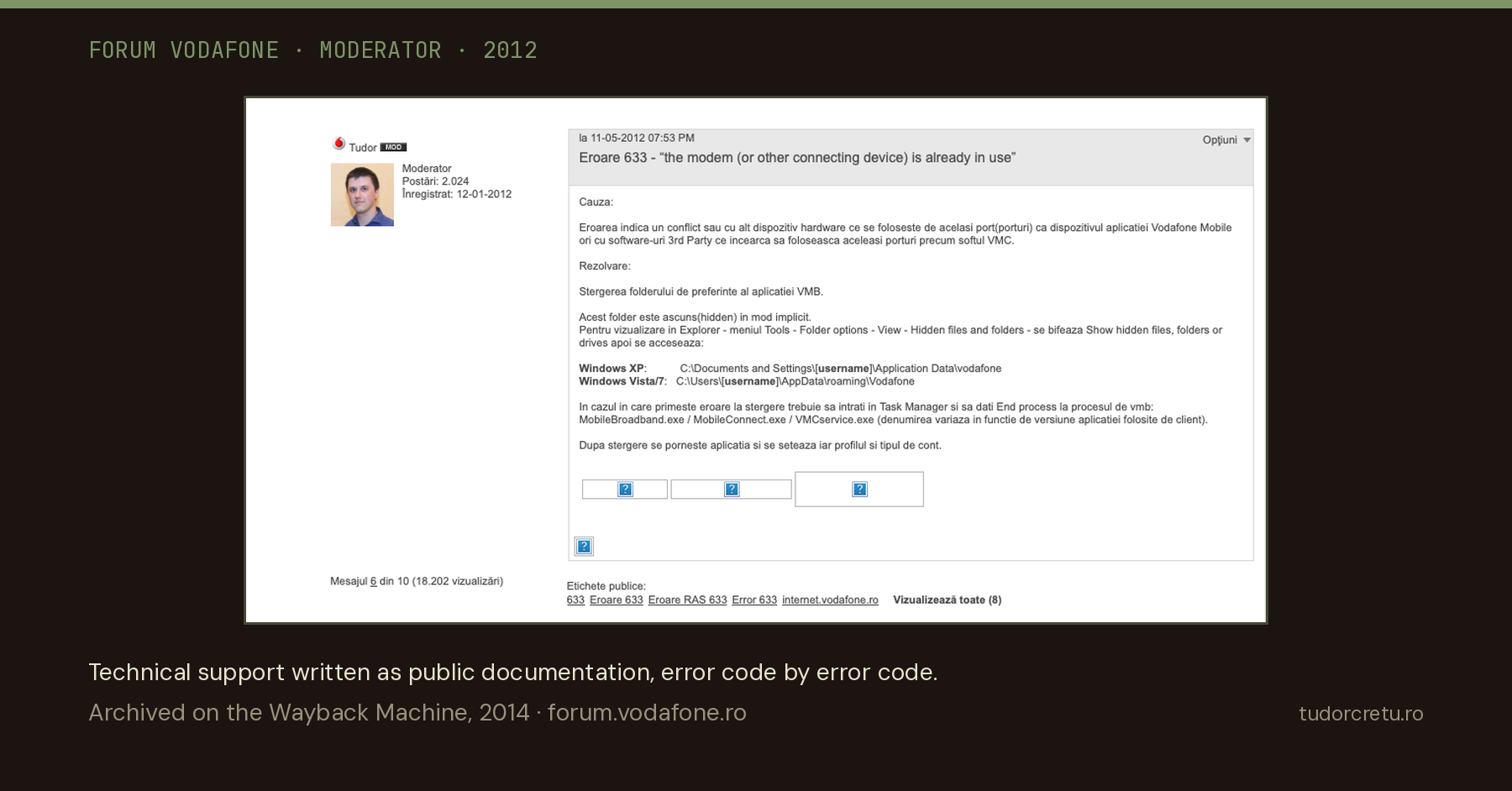
One of those guides was for getting a mobile connection to work, organized by error code: 619, 680, 633, a section each, cause and fix, in plain language. It is still there, archived on the Wayback Machine from 2014. Around eighteen thousand people read that one page.
Here is the part I only understood later: I loved doing it. On the forum, I was constantly pointing from my replies back to articles that backed up what I was saying. I was writing documentation and didn't know it. Now I do. And a year before this, I had done the exact same thing on Softpedia, unpaid, on my own time, before there was any program for it. I was already this person. I just did not have a word for it yet.
I did not stop when I moved on. At Okta and at Microsoft, I kept documenting processes. I left the cleanest handover I could, because I had spent a year and a half mentoring and shadowing the person taking over, before I knew I would leave Microsoft in 2023.
It has broken once. In 2024, back at the same telecom company for an e-commerce role, I walked into Black Friday prep with no docs to inherit and no time to write any. I caught up before I left. The record was there when I walked out.
This month, I started somewhere new. I can tell you exactly what I did on day three.
Halfway through research, demos, and different analyses, I realized the whole thing lived in exactly one person's head. Nowhere else. No document, no diagram, no ticket. So I started writing and reviewed it with the SMEs for technical accuracy.
Written down once, done well, it means nobody spends their time on the same question twice.
Before my first day, I wrote myself a six month plan. Part of it came from one of my mentors. Their advice was blunt, and it stuck: decode every vague term in the job description before you act on it. Do not assume, ask. So the first appendix of my plan is exactly that, a table of every fuzzy phrase in the role turned into a question, and who could answer it.
That plan is the same reflex as the error code guide from 2012. Read first. Write down what is not written down. Only then act.
Here is what I actually believe, and I'll argue for it: the first thing a product owner ships in a new job is not a feature. It is the documentation that was missing. If a process lives in one person's head, that is not a nice-to-have to tidy up someday. That is the first item on the backlog.
There is a line from Elena Verna I keep coming back to: "AI has made average intelligence incredibly cheap and it has given everyone the vocabulary of expertise." Everyone can say vector database, agents, RAG now, and it has become hard to tell who has actually done the work. My answer to that is boring on purpose. I would rather leave proof of work. A guide from 2012 you can still open. A plan I wrote before I started. A process I documented in my first week. Proof you can check beats words anyone can borrow.
I am not chasing visibility. I am preparing for a world where an AI might decide on a promotion or a new role before a person ever reads my name. When that day comes, I want the proof already on the table.
The habit is fourteen years old. It is the least AI-native thing about me, and it is still the one that pays. Read the docs. Write down what is missing. Then build.
Stick around.
Comments